


WhatsApp has quietly transformed from a personal chat app into the world’s busiest business channel.
It began as a space for friends and family conversations but has now evolved into a platform where customers discover products, confirm orders, and get real-time support.
With features like WhatsApp Business, click-to-chat ads, verified business accounts, and commerce APIs, brands across industries have followed their customers to WhatsApp, making it the default touchpoint for real-time engagement. This shift has opened up massive opportunities, allowing businesses to level up their CX and scale through intelligent automation.
In this blog, we’ll explore 10 ways AI agents are shaping the next wave of WhatsApp business automation.
How AI agents are redefining WhatsApp automation for business
Advancements made in AI and automation are remarkable, and they’ve now made their way to WhatsApp, where chatbots can do far more than scripted replies based on rigid logic flows. Traditional bots often felt robotic and limited, but today’s AI agents bring human-like understanding and contextual intelligence to every chat.
Modern AI agents can interpret intent, recall past context, and execute complete workflows like bookings, payments, or onboarding. This evolution transforms WhatsApp from a simple support channel into a powerful space for lead generation, conversion, and end-to-end customer engagement, and here’s how it’s happening:
1. They deliver 24/7 instant, contextual support
Customer expectations have evolved, and they now want brands to respond like friends: fast, personal, and human. Real-time replies are non-negotiable, driving businesses to adopt AI agents that never clock out. These agents deliver instant, always-on support without fatigue, delay, or errors.
They understand intent, recall past interactions, and pull details from CRMs to respond with full context, making conversations feel natural, human, and consistent across every touchpoint.
The impact:
This enables businesses to offer continuous, high-quality support at scale without expanding their teams. Response times drop from hours to seconds, and customers get consistent answers at any hour, building trust, loyalty, and long-term retention.
Real-world use cases:
A logistics company can deploy AI agents on WhatsApp to handle both simple queries like shipment tracking and more complex ones like delivery reschedules, even in the middle of the night.
2. They scale without expanding your team
Growth often brings a flood of customer conversations where every sale, launch, or campaign adds pressure on support teams as queries pour in. Earlier, that meant hiring more agents. But with AI agents, businesses can scale instantly, handling thousands of chats at once without adding headcount.
These AI agents manage repetitive queries, qualify leads, and resolve common issues automatically, freeing human teams to focus on higher-value work.
The impact:
Businesses can now grow without the growing pains of maintaining quality during demand surges. Teams stay lean, operations stay efficient, and customers never experience slowdowns, no matter how busy things get.
Real-world use case:
An eCommerce brand running a festive sale can deploy AI agents to manage seasonal order tracking, product recommendations, and refund requests in real time, without a single miss.
3. They integrate seamlessly across business systems

Customer conversations are connected to data across CRMs, ERPs, and payment systems. When teams have to manually jump between these tools it slows them down and breaks context. AI agents fix that by integrating directly with your existing stack, fetching, updating, and acting on data in real time.
The impact:
This deep integration makes every chat actionable, not just conversational. Businesses can trigger refunds, update records, process payments, or schedule appointments right within WhatsApp, leading to faster resolutions, less manual work, and a unified customer experience.
Real-world use case:
A fintech company can automate loan updates and EMI reminders on WhatsApp with AI agents that process confirmations or reschedule requests by syncing with backend systems, creating a seamless loop between chat and action.
4. They turn every chat into a personalized experience
Customers expect quick yet personalized replies from brands. AI agents cater to this by making every interaction feel one-to-one by learning from past conversations, purchase history, and preferences.
They recognize returning customers, recall previous orders, and tailor responses in real time, turning routine chats into meaningful, loyalty-building experiences.
The impact:
Personalized engagement drives higher conversions, stronger retention, and lasting brand relationships. Every interaction becomes an opportunity to strengthen brand relationships instead of just resolving tickets.
Real-world use case:
A dental clinic can use AI agents on WhatsApp to send care instructions before or after a visit, or suggest follow-up treatments, turning routine messages into personalized, loyalty-building interactions.
5. They transform WhatsApp into a revenue engine
WhatsApp is shifting from a support channel into a powerful sales touchpoint with open rates above 95%, outperforming email and SMS in capturing attention. AI agents take it further by turning every chat into a conversion opportunity, upselling, cross-selling, and re-engaging leads based on real-time behavior.
The impact:
Every message becomes a timely sales opportunity as AI automates conversations that drive revenue without adding to marketing effort.
Real-world use case:
A fintech brand can use AI agents on WhatsApp to re-engage users who abandoned loan applications with timely nudges, driving instant action.
6. They enable proactive, rule-based engagement
Most customer communication is reactive, where brands wait for users to reach out. AI agents flip that by initiating chats automatically based on behavior, time triggers, or workflows.
They keep customers engaged with reminders and prompts at the right time, independently, without human effort. Businesses can define rules once and let the agent take care of execution and timing.
The impact:
Proactive outreach keeps users connected and informed, helping brands stay top of mind, reduce churn, and build lasting relationships while cutting down hours of manual follow-ups.
Real-world use case:
A healthcare provider can use AI agents on WhatsApp to send appointment reminders, follow-up care tips, reschedule visits, and more without human effort.
7. They reduce errors and maintain brand consistency
AI agents ensure every chat stays accurate, compliant, and on-brand, eliminating the inconsistencies that come with human teams. By drawing from approved knowledge bases and templates, they deliver precise, policy-aligned responses across finance, healthcare, and other high-compliance industries, minimizing costly errors and missed disclosures.
The impact:
Businesses can scale communication confidently, ensuring every message reflects their brand voice and standards, building trust and maintaining compliance without sacrificing speed.
Real-world use case:
A bank can use AI agents on WhatsApp to deliver KYC steps consistently across millions of users, ensuring compliance, accuracy, and a uniform brand tone in every interaction.
8. They collect, analyze, and leverage insights
Every WhatsApp chat holds valuable data like common queries, hidden frustrations, star features, and more. AI agents surface these insights by tagging intent, detecting sentiment, and spotting trends across conversations.
Over time, this feedback loop improves customer experiences, refines messaging, and even uncovers new product opportunities.
The impact:
This continuous intelligence turns reactive support into proactive optimization, helping marketing refine messaging, product teams fix issues, and sales anticipate objections using real customer data.
Real-world use case:
A healthcare provider can use AI agents to analyze frequent queries about tests or treatments to find gaps in operational processes, communications, and patient experience.
9. They continuously learn and self-optimize
Modern AI agents get smarter with every interaction, refining their understanding of intent, tone, and context. They adapt to new products, markets, and languages without manual updates, evolving alongside the business to deliver more accurate, relevant, and on-brand responses over time.
The impact:
Continuous learning keeps AI agents sharp and aligned with customer needs, improving efficiency and automation over time without added training costs.
Real-world use case:
A fintech AI agent can evolve from answering setup questions to giving personalized onboarding tips, improving user activation automatically.
10. They make automation accessible for every business size
AI-driven automation is no longer just for enterprises. Several platforms now allow small and mid-sized businesses to deploy intelligent WhatsApp agents without coding. These agents can handle lead capture, order updates, and customer support at scale, delivering enterprise-grade capabilities at minimal cost.
The impact:
No-code AI lets businesses of any size match larger competitors in responsiveness and personalization, freeing teams to focus on growth.
Real-world use case:
A fintech startup can use an AI agent on WhatsApp to automate onboarding, alerts, and support, achieving enterprise-level efficiency without extra staff.
How Swiftsell is powering the future of WhatsApp automation
Swiftsell is transforming WhatsApp automation with intelligent, goal-driven AI agents. Its AI-first platform combines knowledge-based automation, an AI-powered inbox, and workflow orchestration to manage entire customer journeys across lead qualification, payments, post-sale support, and beyond, with context, accuracy, and brand consistency.
Focused on fintech and healthcare, Swiftsell helps businesses scale personalized, compliant interactions while automating complex workflows. Teams can streamline onboarding, handle queries, send reminders, and provide proactive guidance within WhatsApp, without extra technical effort.
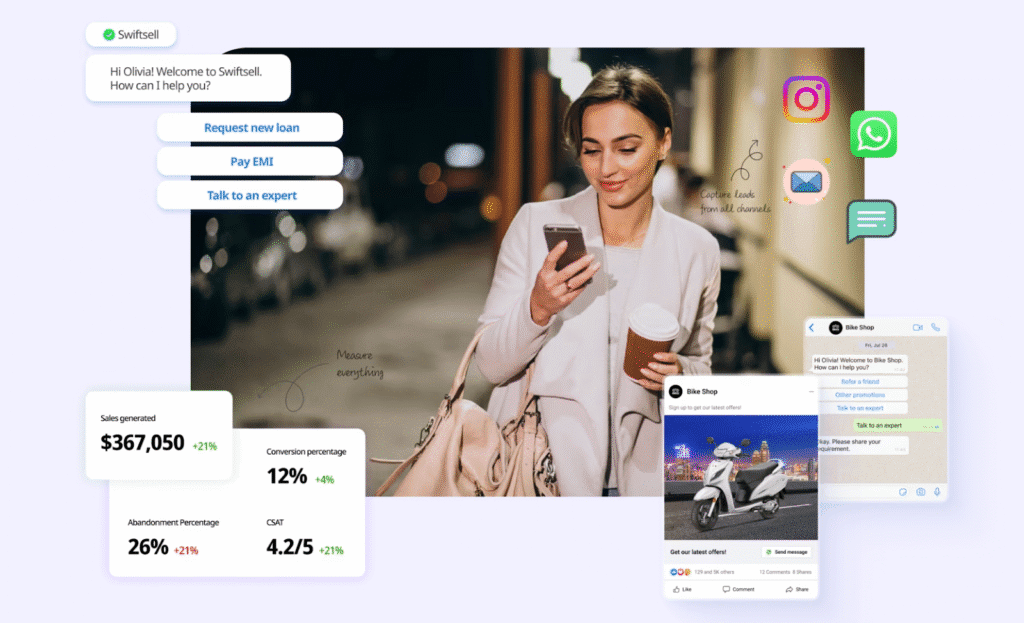
This unified platform reduces response times, boosts engagement, and turns every chat into an opportunity for growth. Swiftsell’s AI continuously learns from interactions, making every conversation smarter, more relevant, and increasingly effective at driving results.
Conclusion
AI agents aren’t here to replace human teams, but they amplify productivity by handling the heavy lifting of routine tasks.
They combine speed, context, and intelligence, turning WhatsApp into a highly effective channel for business automation. Companies that embrace this shift today won’t just meet customer expectations, they’ll set new benchmarks for engagement and efficiency, winning over customers time and again.
Swiftsell helps businesses deploy AI agents that understand context, automate workflows, and engage customers intelligently on WhatsApp. It’s not just automation, but conversation-led growth powered by true AI.